6. Miracles

Christian: Did you see the match last night? I still can’t believe it. Real Madrid was down by three goals in the last ten minutes. The final score? 4-3. They finally won against Barcelona. It was an absolute miracle.
Albert: (Chuckles) A magnificent comeback, yes. But a miracle? That word has become journalistic hyperbole for "unlikely event.". It reminds me with our discussion before about The Resurrection, we’re talking about the central claim of Christianity—the ultimate miracle, and frankly, I don’t believe in miracles in general. How can I? A miracle, by my definition, is a violation of the laws of nature, and therefore impossible.
Christian: I know that’s the common, pop culture understanding, Albert, and it’s precisely where the philosophical mistake lies. A miracle isn't about breaking the laws of nature; it’s about intervention from outside the system.
The core question isn't about a specific event; it's about the worldview. If we assume, as you seem to, that nature is a Closed System —a self-contained mechanism operating only under its own fixed rules (a view called Naturalism)—then miracles are impossible by definition. Nothing can enter or intervene from the outside, but what if the universe is an Open System —a creation made by a reality greater than itself (Supernaturalism)? If the system is open, then intervention is logically possible. This moves the discussion from the absurdity of miracles to a challenge about which worldview is more coherent. If we start with the assumption of the possibility that our system could be an open system, this automatically moves the discussion to investigating whether miracles happen, through gathering evidence about their correctness.
Albert: I see the shift in logical starting point. But philosophers would still argue that our uniform experience of nature’s laws makes the testimony for a miracle infinitely less probable than the testimony being mistaken. They say a wise person proportions their belief to the evidence, and the evidence against a miracle (the existence of natural law) is overwhelming.
Christian: That objection relies on a misunderstanding of what a natural law actually is. Let’s challenge how we understand them. What is a miracle? It’s not a violation of the laws, but an intervention. Consider the law of gravity: "An apple dropped in a vacuum will fall to the ground." This law describes the regularity of the system. If an agent from outside the system—say, a human hand—intervenes and catches the apple, did the law of gravity fail?
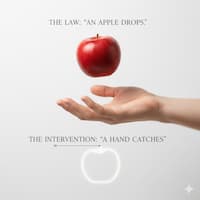
Albert: No.
Christian: The law is still true; it just describes what happens if nothing else intervenes. The law of gravity doesn't preclude the existence of hands or human free will. The intervention of a supernatural Agent is like that hand. The laws of nature, paradoxically, are what allow us to identify a miracle. It’s because we know the reliable regularity that we can recognize the intervention and say, "Wait, this is broken." Think about me: if I come to your place every single day at exactly 8:00 AM, and one day I'm two hours late, you don't conclude that the law of time-keeping has been violated. You start to wonder what external event—a traffic jam, a detour, or an urgent call—changed my path. The delay doesn't destroy the law of my routine; it requires an explanation from outside the routine.
Albert:That addresses the logical possibility, but what about the chronological objection? The common argument is that miracles belong to a primitive, pre-scientific age. People back then were supposedly naïve, ready to label any successful harvest or unusual event as divine, but we tend to condescend to ancient people.
Christian: Biblical accounts show a distinct resistance to the very concept of a miracle. When The Christ performed miracles, people were often astonished, skeptical, or even hostile. The disciples themselves resisted the news of the Resurrection. If they were simple people ready to believe any myth, why the pervasive skepticism? The people who witnessed the miracle often needed evidence before believing, which contradicts the idea that they were easily misled children of a pre-scientific era.
For instance, after the Resurrection, Thomas insisted, "Unless I see in his hands the print of the nails, and put my finger into the print of the nails, and put my hand into his side, I will not believe." That's a demand for empirical evidence! Or consider the royal official whose son was healed at a distance: he didn't believe until he verified the exact time the fever left his son. This isn't credulity; it's a desire to correlate the claim with factual data. He wanted to know if what happened is just a correlation or a coincidence or a causation that this healing is due to the words of Jesus.
Albert: But even if it's possible, the probability of something so complex and unique happening is virtually zero. You still have to play by the numbers.
Christian: That’s another fundamental error. The whole idea of applying probability to a miracle is meaningless. Think about a simple board game like Monopoly. If you land on a square, you can calculate the probability of rolling a specific number on the next turn—say, a six—because you know the rules and the six sides of the die. You're working within the system. But what if the Inventor of the game, who is sitting next to you, decides to simply reach down and move your piece directly to the winning square? The probability of you rolling a six becomes completely irrelevant. The calculation of internal probability is useless because the outcome wasn't caused by chance inside the system; it was a deliberate action from the Creator who stands outside the game. Once we accept the Open System, probability as a tool to disprove the miracle collapses.
So, the goal here is to move the concept of a miracle from the realm of the impossible-by-definition to the realm of the possible. Once we accept the universe as an Open System, created by a Mind that is transcendent, miracles are no longer an absurdity. They become, simply, an exercise of power from the Inventor over the machine.
Albert: That’s a powerful logical restructuring. We can no longer dismiss miracles on the grounds of logical impossibility. We must now approach the question of whether they actually happened, and look for the quality of the evidence.
Christian: Exactly. If it’s possible, we then do what we do with any historical event: gather the evidence, study the claims, and assess the probability of the testimony. If you want to dive deeper into this framework and the philosophical structure of the "Open System" idea, I highly recommend C.S. Lewis's book, Miracles.